
Last updated October 16, 2026
 Wrought iron
 Wood & steel frame
 Farm & ranch
 Sliding driveway gates
 LiftMaster operators
Free on-site gate assessment - hinges, posts, and your LiftMaster or Nice gate operator checked before anything is quoted
The assessment is free and the quote is the invoice.
Get your free estimateDIY vs Professional Gate Repair: The Dallas Homeowner’s Decision Guide
Most gate repair calls we run in Dallas start the same way: a homeowner watched a video, opened the control box, and now the gate won’t move at all. The limit switch adjustment looked simple, and it was. What the video didn’t show was the entrapment sensor wiring six inches away. The line between a DIY gate repair and a professional one isn’t about handiness or saving a hundred dollars. It’s about whether the task in front of you has a failure mode that creates liability, voids a warranty, or needs equipment that sits on a service truck, not in a garage. This guide draws that line precisely: which repairs Dallas homeowners complete safely every week, which ones look simple but carry real risk, and how to tell which side of the line your specific problem falls on. For more detail on professional services, see our Gate Repair page.
Quick Answer
Remote reprogramming, sensor cleaning, battery replacement in keypads and remotes, and light lubrication are legitimate DIY gate repairs for Dallas homeowners. Browse our more guides & resources for additional help. Anything involving a motor, control board, limit switch adjustment, or the physical gate structure itself should be handled by a professional, because these systems have failure modes that can injure someone, void manufacturer warranties, or create a larger repair bill than the original problem. When in doubt, the deciding question is not “can I do this?” but “what happens if I do this wrong?”
Styles & brands we work with
Table of Contents
- Gate Repairs Dallas Homeowners Can Safely Handle
- Gate Repairs That Need a Technician, and Why
- The Three DIY Gate Repairs That Create Bigger Problems
- Texas Liability: What a Homeowner-Repaired Gate Means for Insurance
- Using Manufacturer Documentation to Assess a Task
- The Cost Math on Borderline Repairs
- What Tools a Homeowner Actually Has vs. What a Technician Carries
- Dallas Climate and Gate Wear: What Fails Here First
- Common Mistakes to Avoid
- When to Call a Professional
- Frequently Asked Questions
Gate Repairs Dallas Homeowners Can Safely Handle
Some gate tasks are designed to be owner-serviceable, and the manufacturer says so in the manual. These repairs have no meaningful failure mode that injures someone or destroys equipment. In Dallas, where summer heat kills batteries faster than most of the country, homeowners do these regularly.
Remote and keypad battery replacement. This is a five-minute job. Slide the cover, swap the battery, test the signal. Nothing here can hurt you or the gate. If the remote still won’t work after fresh batteries, the problem is in the receiver board or the remote itself, and that’s a different conversation.
Photo eye and sensor cleaning. Dallas dust, pollen, and the occasional mud splatter from a storm will coat photo eye lenses. Cleaning them with a dry cloth or mild glass cleaner fixes a surprising number of “gate won’t close” calls. The photo eye is a safety device, but cleaning its lens is explicitly covered in owner manuals for BFT, Linear, and Ghost Controls systems.
Track and lubrication on sliding gates. A dry track makes the motor work harder and trips the force sensor. Wiping the track clean and applying a light lubricant to the wheels is owner-level work on most sliding gates. Stick to what the manual recommends: some systems want a dry lubricant, others specify a light grease. Using the wrong product on a Viking or Linear track attracts dust and makes wear worse.
Removing debris from the gate path. Branches, rocks, kids’ toys blocking a photo eye or jamming a wheel. Move the obstruction, test the gate, done.
The common thread: these tasks don’t require opening the motor housing, touching wiring, or adjusting mechanical stops. If you can complete it without a screwdriver touching anything except a battery cover, it’s probably safe DIY territory.
Gate Repairs That Need a Technician, and Why
The tasks below share one trait: they involve a failure mode that is dangerous, expensive, or both. A homeowner can technically perform some of them. But the risk equation changes when the consequence of a mistake is a 400-pound gate moving on its own, or a control board that no longer stops the gate when a child stands in its path.
Limit switch adjustment. The limit switch tells the motor where to stop. Set it too far and the motor rams the gate into the end post, burning out the motor over time. Set it too short and the gate leaves a gap wide enough for a dog or a person to slip through. The adjustment itself is simple. What’s not simple is that the same control board managing limit switches also manages the entrapment protection system. In our experience in Dallas, a homeowner who adjusts one without understanding the other can create a gate that no longer stops when it hits an obstruction, and that’s a safety hazard, not a convenience problem.
Control board replacement. A control board is a circuit board with line voltage running through it. Replacing one means matching the exact board revision to the motor model, transferring settings, and testing entrapment protection afterward. Get the revision wrong and the board won’t talk to the motor. Skip the entrapment test and you’ve disabled the gate’s primary safety system. This is not a parts-swap job for a weekend.
Spring and tension work on cantilever or swing gates. Cantilever gates ride on rollers and don’t use springs, but swing gates with heavy steel frames often do. Springs under tension store energy. Release it incorrectly and that energy goes into whatever is closest, which is usually the person working on it. A gate spring unloading can break bones. This is firmly professional territory.
Motor or operator replacement. Replacing a swing or slide operator means mounting it correctly, setting the mechanical stops, wiring the power, configuring the force settings, and testing the entrapment system. Done wrong, the gate can close with enough force to seriously hurt someone. For the homeowner, this isn’t a skills question; it’s an equipment and liability question.
Welding and structural repairs. If the gate frame is cracked, sagging, or the hinge post is pulling away from the brick or stone, you need a welder and possibly a concrete contractor. This is not a repair; it’s a structural remediation.
The Three DIY Gate Repairs That Create Bigger Problems
Over years of running gate repair calls in Dallas, we see the same three DIY failures repeat. Each one starts with a reasonable task and ends with a bigger bill than the original problem.
-
Adjusting the force setting to “fix” a dragging gate. A gate that drags or stops midway usually has a mechanical problem: a worn roller, a sagging frame, a dry track. Some homeowners notice their motor has a force adjustment and turn it up. Now the motor pushes harder, which masks the mechanical issue while accelerating wear on the motor, the gear train, and the track hardware. What would have been a $150 roller replacement becomes a $600 motor replacement six months later. The correct fix is almost always mechanical, not electronic.
-
Water intrusion during a DIY board or wire splice. Dallas gets hard thunderstorms. Wire splices and control board installations that aren’t properly sealed let moisture in. The first storm shorts the board. Worse, if the board was installed without proper grounding, the short can travel to other components. We’ve replaced entire control enclosures because a homeowner spliced a wire with electrical tape and no weatherproof sealant. A weatherproof splice kit costs under $20 at any Dallas hardware store, but it has to be done right.
-
Replacing a gear without addressing the root cause. On swing gate operators, a stripped gear is often the symptom, not the disease. The disease is a gate that’s out of balance, which makes the operator fight gravity every cycle. A homeowner replaces the gear. The gear strips again in a few months because the gate is still out of balance. A technician would have corrected the balance, then replaced the gear. The homeowner pays for two gears and then a technician visit. The technician visit was the cheaper path from the start.
Texas Liability: What a Homeowner-Repaired Gate Means for Insurance
Here’s the part most DIY gate repair guides skip. Automated gates are entrapment protection systems, and Texas law treats them that way. UL 325 is the safety standard that governs automatic gate operators. When a manufacturer ships a gate motor, it’s designed and tested to meet UL 325. When a homeowner alters the system without following the manufacturer’s installation and maintenance procedures, that UL 325 listing is no longer valid.
What does that mean practically in Dallas? If a homeowner-repaired gate injures someone, the homeowner’s insurance carrier will ask questions. Was the repair done by a qualified person? Was the entrapment protection tested after the repair? Was the gate operating within manufacturer specifications? If the answer to any of those is no, the carrier can deny coverage or raise the premium significantly. A professionally repaired gate transfers some of that liability, because the repair is documented, the technician tested the safety systems, and the work carries a written guarantee.
This isn’t a scare tactic. It’s how the insurance industry has operated for decades around pools, electrical panels, and gas lines. Gates joined that list because they’re large mechanical devices installed at the edge of a property, and the failure mode is documented and litigated. In Texas, where properties are large and gates are common on acreage lots in the Dallas suburbs, the exposure is real.
Using Manufacturer Documentation to Assess a Task
Every gate motor has a manual. The manual divides maintenance and repair tasks into owner-serviceable and technician-only, and it says so explicitly. This is the single most underused tool in the DIY decision process.
Here’s how to use it:
-
Find your model number. It’s on a sticker on the motor or on the inside of the control box cover. Write it down. This is the key to everything.
-
Download the manual from the manufacturer’s site. BFT, Linear, Viking, and Ghost Controls all publish their manuals as PDFs. Search the model number and “manual pdf.”
-
Look for the maintenance section. It will have a table. Tasks labeled “owner” or “user” are safe DIY territory. Tasks labeled “qualified technician” or “dealer only” are not.
-
Check the troubleshooting chart. The troubleshooting chart tells you what to check before calling a technician. It will also tell you what not to touch. Many charts explicitly say “do not adjust” next to force settings and limit switches.
-
If the manual is silent on a task, treat it as technician-only. Silence on a repair procedure is not permission. It usually means the manufacturer doesn’t consider it owner-serviceable.
One more note: if your gate motor is a Ghost Controls or Viking, those brands are popular with homeowners because they’re sold at retail. That retail availability creates a false sense that everything on the unit is owner-serviceable. It’s not. The retail channel exists so homeowners can buy and basic-install entry-level systems, not so they can service the control board.
Our Gate Motor Repair in Dallas page covers the common motor failures we see across the nine brands we service.
The Cost Math on Borderline Repairs
There’s a category of gate repair that a handy homeowner can do but probably shouldn’t, and the deciding factor is total cost, not the repair cost alone.
Consider a limit switch that’s drifted. A technician adjusts it in 30 minutes and charges a service call plus labor, typically $150 to $250 in the Dallas market. A homeowner watches two videos, spends two hours on a Saturday, adjusts it wrong, and the gate rams the stop. Now the motor is damaged, and the repair is $400 to $800. The homeowner’s “savings” was negative $400 or more.
Now consider a photo eye that’s been knocked out of alignment. Alignment takes a technician ten minutes. Most homeowners can also do this, because there’s no risk in the adjustment. The cost math says: if you’re reasonably sure of the task and the failure mode is benign, DIY makes sense.
The break-even calculation is:
- What does the technician charge for this specific task? In Dallas, service calls run $65 to $125, and labor $75 to $125 per hour. A one-hour repair lands between $150 and $250 total.
- What tools do I need, and do I own them? If you need to buy a $80 multimeter to test a circuit you’re not sure how to test, that’s real money toward a technician.
- What’s the cost if I get it wrong? This is the number homeowers usually skip. If the wrong outcome is a $600 control board or a gate that won’t close and a property that’s now unsecured overnight, the expected value of the DIY attempt goes negative fast.
This is the honest math. The cheapest bid isn’t always the lowest total cost. Sometimes the cheapest total cost is a two-hour technician visit that’s done right the first time.
For a broader look at what we do, see our Gate Repair in Dallas page.
What Tools a Homeowner Actually Has vs. What a Technician Carries
The tools on a gate repair truck aren’t a mystery, and knowing what’s there clarifies why some jobs cost a service call fee. A homeowner in Dallas typically has: a cordless drill, basic wrenches and sockets, a multimeter maybe, and a willingness to figure it out.
A technician carries:
- A torque wrench for mounting bolts that have a specified torque value. Over-tightening a swing operator mount on a brick column cracks the brick. Under-tightening it lets the operator walk under load.
- A gate-specific multimeter that reads AC and DC voltage, continuity, and amperage draw on motors. Testing a motor’s current draw under load tells you if the motor is healthy or dying.
- Weatherproof splice kits rated for burial and wet locations. This is not electrical tape.
- A loop detector tester for verifying that vehicle loop detectors at the driveway are working. In Dallas, where most upscale properties have loop detectors cut into the concrete, testing them requires equipment the homeowner doesn’t own.
- Replacement hardware in correct grades: stainless bolts, correct-length lag screws, specific hinge pins. The difference between a Grade 5 and Grade 8 bolt matters when it’s holding a 500-pound cantilever gate.
- Model-specific parts for LiftMaster, FAAC, BFT, Linear, Viking, Ghost Controls, DoorKing, Elite, and Mighty Mule. A homeowner ordering parts online often gets the wrong revision or a knockoff, and then pays a technician to diagnose the wrong part failure.
None of this is exotic. But the combination of the right tools and the right parts means a service call that takes an hour instead of a weekend that ends with a non-working gate and a Monday phone call anyway.
Dallas Climate and Gate Wear: What Fails Here First
Dallas has a climate that’s hard on outdoor mechanical equipment. Triple-digit summers, freeze-thaw cycles in winter, torrential spring storms, and dust that gets into everything. Each of these has a specific effect on gate systems.
Heat kills batteries and plastic gears. Gate remotes and keypad batteries in Dallas last half as long as they do in cooler climates because the heat accelerates chemical discharge. Plastic gears inside swing operators get soft at 100-degree ambient temperature, which is why gear failure in Dallas tends to happen in August. If your gate stops working on the hottest day of the year, the gear is the first suspect.
Freeze-thaw heaves concrete and misaligns tracks. When moisture gets under a sliding gate’s concrete track or under a hinge post and freezes, it expands. Repeated cycles shift the alignment. A gate that worked perfectly in October may drag by February. The fix is usually mechanical realignment, not motor adjustment.
Storms flood low spots and short exposed wiring. Dallas thunderstorms drop inches of rain in hours. Control boxes mounted low in the driveway, splice junctions that aren’t sealed, and wire runs in conduit that has been disturbed all become water intrusion points. After any heavy storm, check the control box for moisture before you touch anything inside.
Dust coats photo eyes and limit switches. The same dust that coats cars in Dallas gets inside gate housings. Photoe eyes fail from dirt buildup. Limit switches drift because dust particles accumulate on their contact surfaces. A can of compressed air and a soft cloth fixes a surprising number of these issues, and that’s an owner-level task.
If you’re planning a new gate or a full replacement, our Gate Installation in Dallas page covers what a proper Dallas installation includes.
Common Mistakes to Avoid
- Opening the control box while the power is on. Line voltage inside a gate control box can kill. Always kill the breaker, verify with a non-contact voltage tester, and then open the box. Skip the tester and you’re trusting a breaker you didn’t verify.
- Using WD-40 on gate hinges and tracks. WD-40 is a solvent, not a lubricant. It cleans and then evaporates, leaving the metal drier than before. Use a lithium grease or whatever the manufacturer’s manual specifies.
- Turning up the force setting to fix a dragging gate. Covered above, but it bears repeating. You’re not fixing the problem; you’re floating it and creating a bigger one.
- Buying a “universal” remote and expecting it to work. Universals work with some receivers and not others. If you have a BFT or Viking system with a rolling-code receiver, the universal may program once and then drop the code. Match the remote to the receiver, not the brand on the gate.
- Skipping the entrapment test after any electrical work. Place an obstruction in the gate’s path and see if it reverses. If it doesn’t, the entrapment protection is not functioning, and the gate should not be used until a technician corrects it. This is a safety test, not an optional step.
- Assuming a gate problem is electrical when it’s mechanical. Most gate failures are mechanical: a worn roller, a sagging frame, a bad hinge. Homeowners often replace the motor or board first because that’s what they can order online. The mechanical diagnosis comes first.
When to Call a Professional
Call a professional when the task involves any of these: the motor or operator itself, the control board, the limit switches, the entrapment protection system, springs under tension, or any structural component of the gate frame, post, or track. Also call if you’ve already attempted a DIY repair and the gate isn’t working, because now the problem has a layer of homeowner-introduced variables on top of the original failure. Carver Gate Repair Dallas offers free estimates in Dallas, and we give every customer a written price before any work starts. Call (940) 531-9746 and a live person answers, 24/7.
Frequently Asked Questions
Most gate repairs in Dallas range from $150 to $600, depending on the task. A service call and minor adjustment runs $150 to $250. A control board replacement runs $400 to $800. A full motor replacement runs $700 to $1,500. Every Carver Gate Repair Dallas job includes a written price before the work starts, so the number never moves at the door. Call (940) 531-9746 for an exact quote on your system.
You can, but you shouldn’t. A gate motor replacement involves mounting the operator correctly, setting the mechanical stops, wiring the power, configuring the force settings, and testing the entrapment protection system. Get any of those wrong and the gate can close with enough force to seriously injure someone. This is a UL 325 regulated installation, and the liability exposure in Texas is real. A professional replacement also carries a written guarantee, which a DIY replacement doesn’t.
Remote and keypad battery replacement, photo eye cleaning, track and wheel lubrication on sliding gates, and removing debris from the gate path are all owner-level tasks. These jobs don’t require opening the motor housing, touching wiring, or adjusting mechanical stops. Check your motor’s manual for the official owner-serviceable list, which varies by brand.
Listen and look. If the motor hums but the gate doesn’t move, the problem is mechanical: a gear, a drive belt, or a physical obstruction. If the motor doesn’t hum at all, the problem is electrical: power, board, or wiring. If the gate moves but stops in the wrong place, the problem is limit switches or a photo eye. This three-way test narrows most calls down before a technician arrives.
No. The force setting exists to prevent the gate from crushing whatever is in its path when entrapment protection fails. Turning it up to fix a dragging gate masks a mechanical problem and compromises the gate’s safety system. If your gate is dragging, the fix is mechanical: a roller, a track alignment, or a balance correction on a swing gate. Call (940) 531-9746 for a straight answer on what your specific gate needs.
In most cases, repairing an existing gate system doesn’t require a permit in Dallas. Replacing an entire gate or installing a new operator on a new gate may fall under fence and access structure permitting, depending on the municipality. Structural work on a gate that’s attached to a wall or involves new concrete may also trigger review. The safest move is to check with your specific city’s building department before you commit to a structural project.
The Bottom Line
The DIY vs. professional question on gate repair is answered by one test: what happens if I get this wrong? If the wrong outcome is a dead battery or a squirt of the wrong lubricant, DIY is fine. If the wrong outcome is a 400-pound gate that doesn’t stop, a voided warranty, or an insurance carrier denying a claim, the technician’s service call is cheaper than the risk. Dallas homeowners who respect that line save money on the repairs they can handle and avoid the bills that come from the repairs they shouldn’t have tried. That’s the whole decision, and it’s a technical one, not a philosophical one.
Written by Lonnie Burke, Owner at Carver Gate Repair Dallas, serving Dallas since 2008.
See the difference
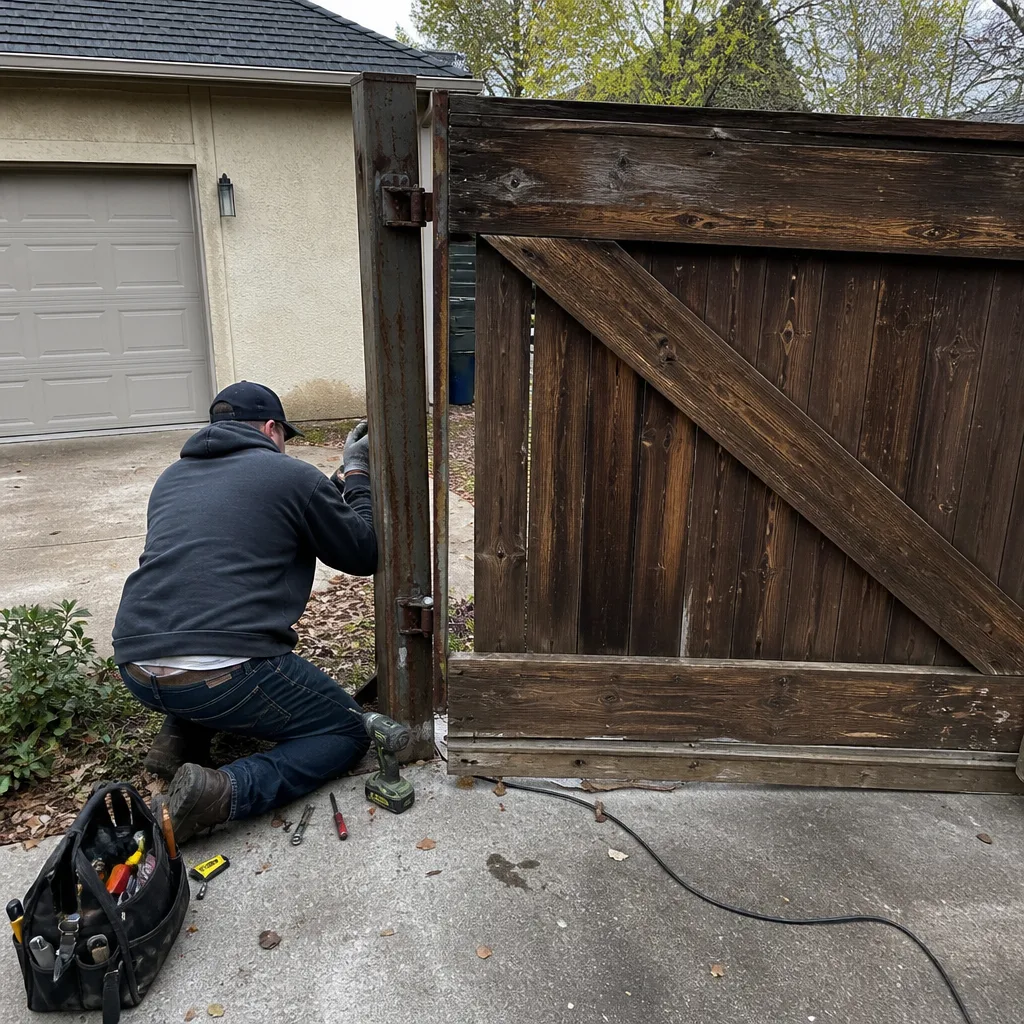 Before
 After
After Before
 After
After Before
 After
After